
Development Process
At Skyniv Atelier, our workflow is a disciplined, multi-stage engine designed for the high-stakes environment of pharmaceutical manufacturing. We transform regulatory text into submission and press-ready assets through a secure path of technical execution.
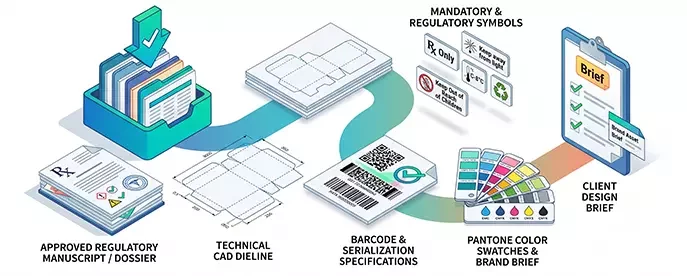
Step 1: Input & Brief
The foundation of a zero-error file begins with a structured intake. To ensure technical alignment from the outset, we follow a rigorous intake validation.
- Asset Submission: Clients provide the Regulatory Text / Manuscript, approved Die-lines, and any specific Brand Guidelines via our secure communication channel.
Completeness Verification: Before development begins, we verify that all technical inputs—including pharmacodes, serialization requirements, and regional mandates—are present and correct.
The Brief Confirmation: We align on the scope, ensuring market-specific requirements (e.g., Braille, GS1 barcodes, or specific spot-color needs) are clearly defined.
Step 2: Artwork Development
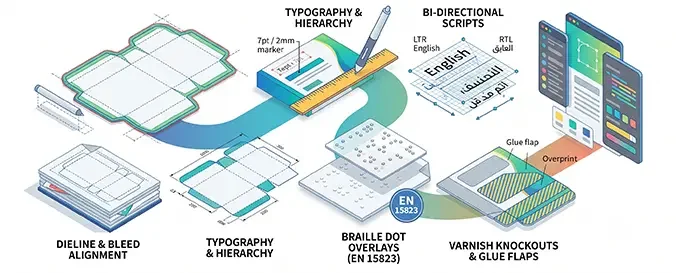
During this phase, our specialists build the "Master File." This is where expertise in pharmaceutical packaging is most critical.
Regulatory Mapping: Precise placement of all mandatory text, warnings, and schedules according to the approved manuscript.
Structural Integration: Synchronizing the artwork with the physical die-line, managing bleeds, glue-flap clearances, and quiet zones for sensors.
Standardization: Mention the global standards such as GS1 DataMatrix and Unique Identification for serialization and track-and-trace readiness.
Phase 3: Quality Check
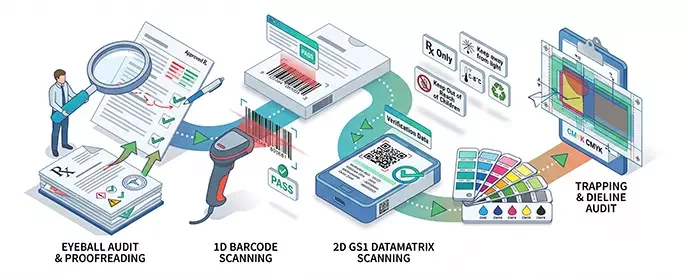
Every file developed by Skyniv Atelier must pass through our quality check. This is an independent verificatoin that occurs before any file is released to the client.
Internal Peer Review: An independent technical person verify the file against our Quality Standard checklist.
Electronic Verification: Barcodes are checked for scanability and data integrity. Font sizes are measured against regional minimums (e.g., the 7pt / 1.4mm legibility rule) or as per client requirement.
Error Correction: Any technical deviations are resolved internally, ensuring that the first version the client sees is already production-compliant.
Phase 4: Review & Approval
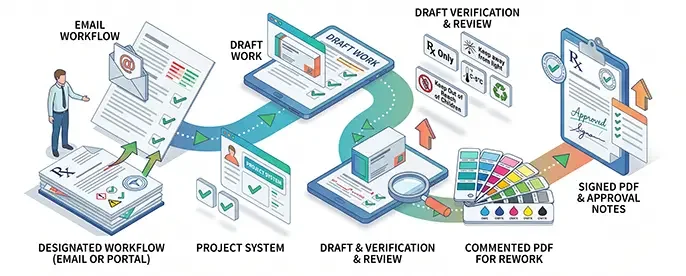
Draft artwork is shared via your designated email or project portal for review. Return a commented PDF if rework is needed, or submit the signed PDF with approval notes for formal sign-off. This guarantees complete regulatory, QA, and brand alignment before press release.
- Dedicated Channel Workflow: Review files seamlessly through your assigned email or project portal track.
- Commented PDF Rework: Submit annotated PDFs for rapid, precise design and layout adjustments.
- Formal Upload Sign-Off: Authorize production by submitting the signed PDF along with approval notes.
- Multi-Department Alignment: Ensure 100% consensus across Regulatory, Quality, and Brand teams prior to locking.
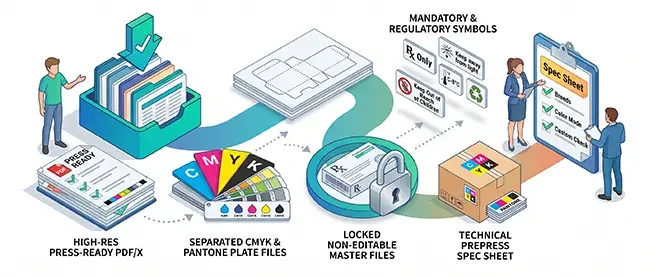
Phase 5: Released Press-Ready Files
The protocol concludes with the delivery of a "Final Master Package" designed for seamless integration into the print supply chain.
The Output: Clients receive a high-resolution, print-ready PDF along with a summary report.
Version Control: All approved artwork's final version is securely archived within our protected digital environment as per policy. This infrastructure provides an impenetrable vault for your proprietary documentation, ensuring that every development stage remains organized and accessible.
Asset Governance: We maintain a single source of truth for your brand, ensuring that only the most current, approved version is accessible for future market adaptations.